When you start working out, you do not need to do ten different exercises every day. Doing too many single-muscle moves can waste your time and leave you feeling tired.
If you want to get strong quickly and safely, focus on compound exercises.
Compound exercises are movements that work two or more major muscle groups at the same time. They save time, burn more calories, and build real-world strength.
Here is a simple guide to the five best compound exercises, how to train your glutes for better posture, and how to balance your upper and lower body workouts.
What Are Compound Exercises?
A compound exercise uses multiple joints and large muscles together.
For example, a bicep curl only moves your elbow and works one small muscle. But a squat moves your hips and knees, working your glutes, thighs, and core all at once.
By targeting major muscle groups in a single movement, you get maximum results in less gym time.
5 Best Compound Exercises for Full-Body Strength
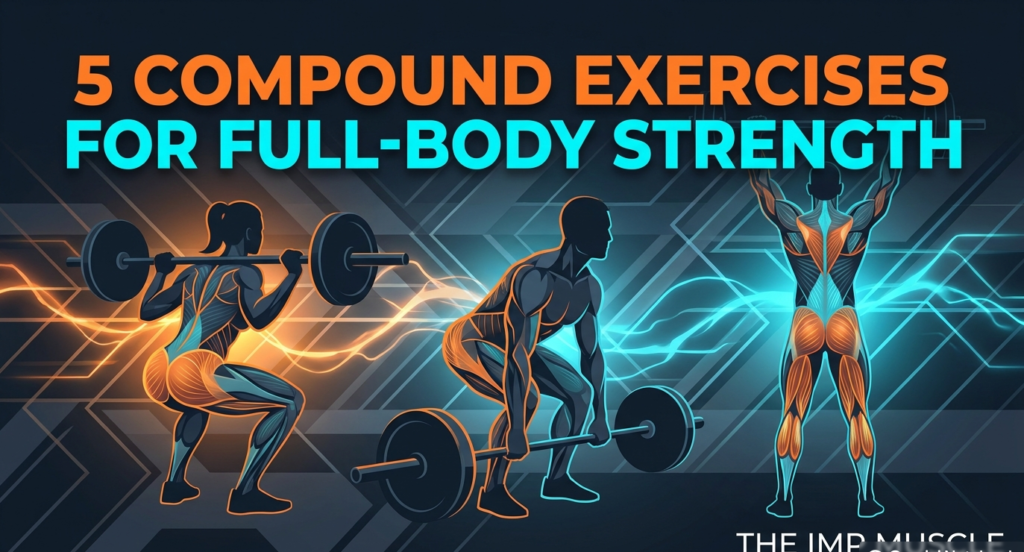
1. The Squat (Legs, Glutes, and Core)
The squat is the king of lower body exercises. It works your quadriceps (front of thighs), hamstrings, glutes, and core.
- Why it helps: Squats build leg power and make daily activities like standing up and climbing stairs much easier.
- How to do it simply: Stand with feet shoulder-width apart. Sit back like you are sitting on an invisible chair, keep your chest up, and stand back up.
2. The Deadlift (Glutes, Back, and Hamstrings)
The deadlift trains your posterior chain—the entire back side of your body.
- Why it helps: It strengthens your lower back, glutes, and grip strength. It also teaches you how to lift heavy objects off the floor safely.
- How to do it simply: Stand close to a weight or kettlebell. Hinge at your hips, keep your back flat, bend your knees slightly, hold the weight, and stand tall by squeezing your glutes.
3. The Push-Up or Bench Press (Chest, Shoulders, and Triceps)
This is your main upper body pushing exercise.
- Why it helps: It builds strength in your chest, front shoulders, and the back of your arms. Push-ups also engage your core to keep your body straight.
- How to do it simply: Start on your hands and toes (or knees). Lower your chest slowly toward the floor, then push yourself back up.
4. The Row (Upper Back, Lats, and Biceps)
A rowing movement is your main upper body pulling exercise.
- Why it helps: Rowing pulls your shoulders back, fixes rounded shoulders from sitting at a desk, and strengthens your upper back.
- How to do it simply: Bend forward slightly at your hips with a flat back. Pull weights toward your stomach, squeezing your shoulder blades together.
5. The Overhead Press (Shoulders, Upper Chest, and Core)
Pressing a weight over your head builds strong shoulders and core stability.
- Why it helps: It strengthens your shoulders and forces your core to stay tight so you do not arch your lower back.
- How to do it simply: Stand tall with weights at shoulder height. Push the weights straight up over your head, then lower them slowly.
Why Glute Training Is the Secret to Better Posture
Many people skip training their glutes or think glute exercises are only for looks. But your glutes (butt muscles) are the largest muscle group in your body!
Here is why glute training is essential for your posture and health:
- Saves Your Lower Back: When your glutes are weak, your lower back has to do all the heavy lifting. This causes chronic back pain. Strong glutes protect your spine.
- Fixes “Desk Posture”: Sitting all day makes your hip flexors tight and turns off your glute muscles. Exercises like glute bridges and hip thrusts wake up these muscles and pull your pelvis into alignment.
- Makes You Lift Stronger: Strong glutes give you power for running, jumping, and lifting heavier weights safely.
Upper Body vs. Lower Body: How to Balance Your Workouts
A common mistake beginners make is training only the muscles they see in the mirror (like chest or biceps) while ignoring their legs or back. This creates muscle imbalances and leads to injuries.
Here is how to keep your workouts balanced:
- Equal Push and Pull: For every pushing exercise (like push-ups), do one pulling exercise (like rows).
- Train Legs Equally: Do not skip leg day. Your legs contain your largest muscles and drive your metabolism.
- Use a Simple Weekly Split:
- Full-Body Routine (3 days a week): Do 1 squat, 1 hinge (deadlift), 1 push, and 1 pull in every workout.
- Upper / Lower Split (4 days a week): Train upper body on Monday/Thursday and lower body on Tuesday/Friday.
Simple Tips for Beginners
- Start Light: Learn the movement with body weight or light dumbbells before adding heavy weights.
- Keep Your Core Tight: Brace your stomach muscles during every exercise to protect your spine.
- Rest 48 Hours: Give your major muscle groups at least 1 to 2 days of rest before training them again.
Start Building Real Strength Today
Focusing on these five compound exercises is the fastest way to build muscle, burn fat, and feel energized. At The Imp Muscle, we make fitness clear, safe, and simple for everyone.